
It’s not about the reward. It’s about the feeling of being one step away from it.
Launching a loyalty programme always brings the same question: why would someone bother collecting points for something they’d buy anyway?
The answer has nothing to do with discounts, because that way we are training customers to expect lower prices. They attract bargain hunters who leave the moment a competitor offers a better deal. But it has everything to do with how the human brain is wired. When a customer reaches Gold, Platinum, or other highest level, they’re not collecting a discount, they’re collecting status and value with your brand.
Once you understand the psychology behind points-collecting, you stop thinking about loyalty programmes as marketing tools and start thinking about them as the most powerful engine your business has for generating consistent, predictable revenue.
1. The brain loves progress, even artificial progress
In 2006, researchers at Columbia University ran a study on coffee shop loyalty cards. One group received a card with 10 stamps to collect. Another group received a card with 12 stamps to collect but with 2 already stamped.
Both groups needed to collect the same 10 stamps to earn a free coffee. But the second group completed their cards significantly faster.
Why? Because getting started feels harder than continuing. When people see a bar that’s already 20% full, their brain doesn’t see a task that’s barely begun, it sees a task that’s already underway. The psychological term for this is the endowed progress effect, and it’s one of the most reliable patterns in consumer behaviour.
The moment your customer sees progress, their brain shifts from ‘should I bother?’ to ‘I’m nearly there.
For the loyalty feature on your app, this means never show an empty progress bar. Give new members a small number of points at sign-up. Start them at tier one, not at zero. Let them feel like they’ve already begun something worth finishing.
2. Dopamine doesn’t fire when you get the reward, it fires in anticipation
A business designs their loyalty programe around the reward itself. Get enough points, receive a voucher. Simple enough.
But neuroscience tells a different story. The dopamine hit that drives repeated behaviour doesn’t peak at the moment of reward, it peaks in the moments of anticipation leading up to it.
Let me explain!
Slot machines are more compelling than a fixed prize draw. The possibility of reward, cycling through on every spin, keeps the dopamine loop active. The same principle applies to daily login bonuses, surprise point multipliers, and mystery rewards.
The practical implication for your app is significant. If your customers only engage when they’re redeeming, you’ve built a coupon system, not a loyalty programme. A genuine loyalty engine creates reasons for people to check in, earn small wins, and stay in that state of pleasant anticipation.
Examples of anticipation-building mechanics:
• Daily mini-games, “spin-to-win” moments, or other interactions tied to purchases that reward streaks and create a sense of curiosity (“What can I get today?”);
• Limited-time point multipliers that introduce urgency, applied to specific products and potentially reinforced by low stock availability;
• Progress milestones with surprise rewards delivered at unexpected intervals, trigger more excitement than predictable ones.
All of them create habitual engagement, which is the difference between a customer who buys from you occasionally and one who thinks of you first.
3. The IKEA Effect : Ownership makes things feel more valuable
In 2011, Harvard Business School published research on what became known as the IKEA Effect. People place significantly have a higher value on things they have assembled or built themselves, compared to identical finished products.
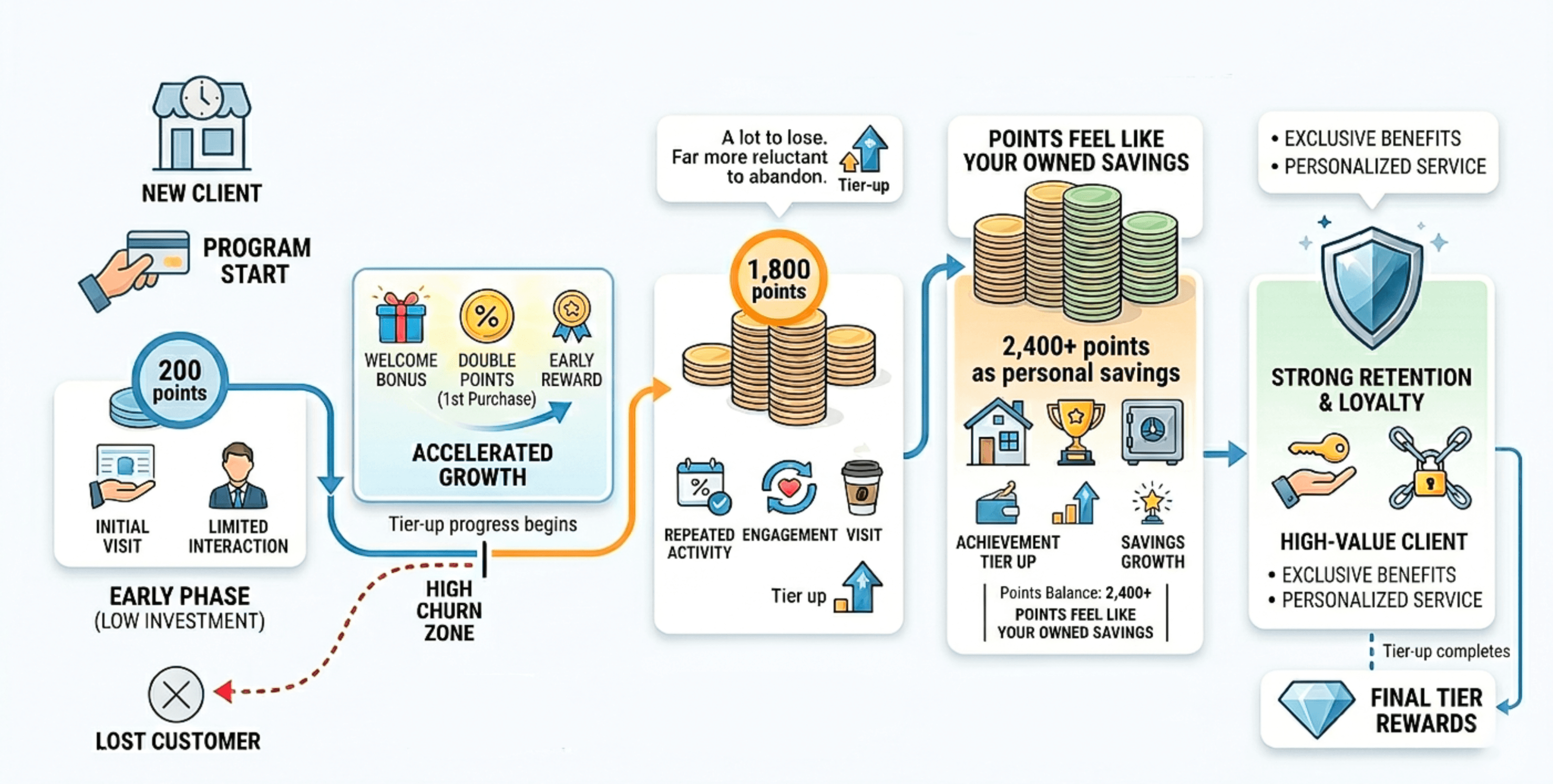
When a customer builds up 2,400 points through their own purchases, visits, and engagement, those points don’t feel like a marketing asset belonging to your company. They feel like something they earned. Something they own.
Points your customers have built up feel like savings in a personal account and people are far more reluctant to abandon an account they’ve invested in.
This is why high programme churn usually happens early. A customer with 200 points from their first two visits has almost nothing invested. A customer with 1,800 points who is 200 away from their next tier has a lot to lose. The design challenge is getting them to that second threshold before they disengage.
The solution is to make early accumulation feel rewarding, through welcome bonuses, double points on first purchases, or a simplified early reward that proves the system delivers.
The bottom line
Loyalty programmes fail when they’re designed as discount systems with a points interface layered on top. They succeed when they’re designed around how humans actually behave, around progress, anticipation, ownership, and status.
The good news is that you don’t need great minds to reinvent the wheel, it just requires better design thinking. The difference between a loyalty app that sits dormant on your customers’ phones and one they open every day is rarely the size of the reward. It’s almost always the quality of the experience around it.
The psychology above isn’t academic. Each principle translates directly into design decisions that either make your loyalty programme something people genuinely engage with, or something they download and forget.
Five design principles for a psychologically effective loyalty app:
• Always show progress. Never show emptiness. Start users with something already earned.
• Create regular small rewards, not just infrequent big ones. Frequency of wins beats size of wins.
• Use variable rewards alongside predictable ones. The surprise multiplier is more powerful than the guaranteed 10% cashback.
• Design your tiers around identity and status, not just savings thresholds. Name them. Make them feel like something worth reaching.
• Make the app worth opening on days when your customer isn’t buying. A leaderboard, a streak, a daily bonus, any reason to return reinforces the habit loop.
The companies winning at loyalty right now aren’t offering more. They’re offering something that feels better to use.
If you’re building a new loyalty app or looking to improve one you already have, the place to start isn’t the rewards catalogue , it’s the experience design. That’s the part that determines whether any of this psychology actually gets to work.