
For decades, software evolution was measured by the number of features available. Organizations invested in more complete platforms, more automated processes, and more efficient interfaces, while users adapted to the increasing complexity of the tools they used daily. Learning how to navigate an application was part of the experience. Manuals, training sessions, and documentation were a natural part of any system adoption lifecycle.
Today, that reality is changing rapidly.
The rise of AI-powered tools such as conversational assistants and digital copilots has fundamentally shifted user expectations. People have become used to interacting with systems that understand context, respond in natural language, and provide immediate help. This shift is driving a quiet but profound transformation in how digital experiences are designed.
The question is no longer simply how to make an interface more intuitive. It is how to design applications that actively collaborate with their users.
This is where the concept of AI-First UX emerges.

From Users Who Learn to Systems That Guide
Most UX methodologies developed over the past decades were built on a simple assumption: users needed to learn how to use the system. The role of design was to reduce that learning curve through clear navigation, consistent information architecture, and intuitive interfaces.
Artificial Intelligence is beginning to invert that logic and the inversion is more disruptive than it appears.
Instead of requiring users to find features and figure out how to perform specific tasks, systems are becoming proactive. Through context awareness and behavioral understanding, they can identify intent, anticipate needs, and surface relevant actions at the right moment.
The experience shifts from asking: “Where is this feature?” to something far more meaningful: “What is the user trying to achieve, and how can I help them get there?”.
That sounds like a subtle difference. It is not. It changes the entire contract between user and system.
The Rise of Digital Mentors And Why the Metaphor Matters
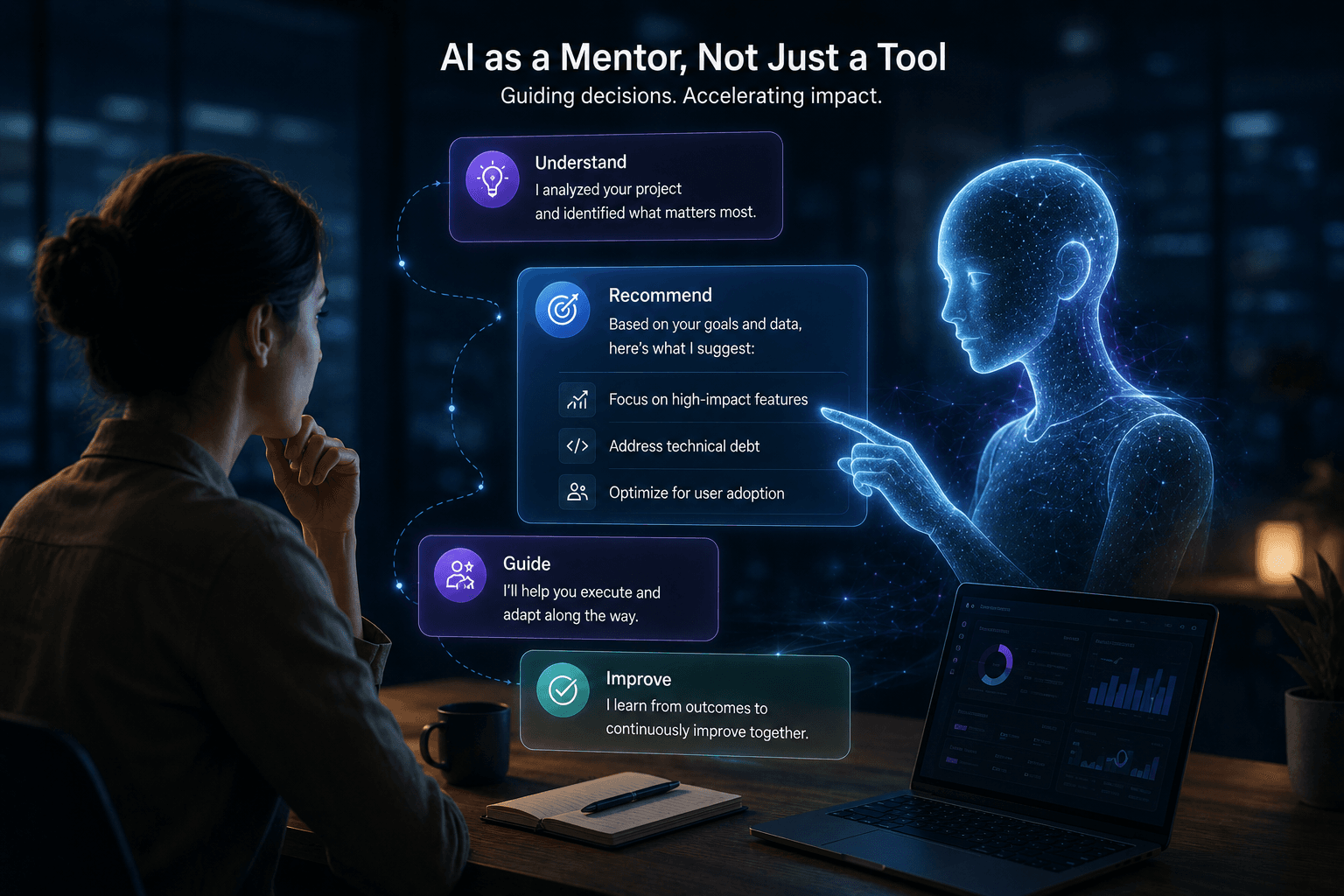
One of the most interesting outcomes of this new generation of software is the emergence of systems that behave less like tools and more like digital mentors.
The distinction is worth unpacking carefully, because it is not just a rebranding exercise.
A tool executes tasks. It waits to be used. It does exactly what it is told, no more. A mentor, by contrast, helps you decide which tasks are worth executing in the first place and then supports you through the process of doing them well.
When a system starts operating as a mentor, three things change simultaneously: it offers contextual recommendations instead of waiting for commands; it explains its reasoning instead of just producing outputs; and it adapts to the user's evolving context instead of treating every interaction as isolated.
This is not science fiction. It is already present in tools like OutSystems Mentor, which supports different stages of the software development lifecycle, helping teams generate applications, validate solutions, identify improvements, and automate repetitive tasks. The distinction between executing and guiding is built into its design intentionally.
But here is where most implementations fall short: they build the AI layer without redesigning the experience around it. The mentor logic gets bolted onto an existing interface that was never designed for that kind of relationship. The result is a system that is technically intelligent but experientially incoherent.
Why User Expectations Have Already Shifted Permanently
Users no longer compare digital experiences only within the same category of enterprise software. They compare everything with everything.
After years of interacting with intelligent assistants and recommendation systems in their personal lives, expectations around speed, context, and cognitive effort have permanently shifted. Long processes, complex navigation, and overloaded interfaces now create friction much faster than before, not because the software has become worse but because the reference point has changed.
Users are no longer comparing software to software. They are comparing it to AI-level responsiveness.
This creates a problem for organizations that continue designing experiences purely around processes and feature sets. They risk building solutions that are technically robust but increasingly misaligned with how people actually expect to interact with technology. The gap between what a system can do and what a user is willing to endure is closing fast.
The Role of UX: Which Becomes More Critical, Not Less
There is a common assumption that AI reduces the importance of UX. If the system is intelligent enough, the thinking goes, the interface almost becomes irrelevant.
This is exactly wrong.
Intelligent systems introduce entirely new categories of design challenge and if UX practitioners are not actively involved in solving them, the systems will fail regardless of their technical sophistication.
The three most pressing challenges are these:
- Trust and transparency. Users need to understand why a recommendation was made, what data informed it, and what assumptions the system is operating under. Without that, even accurate recommendations will be rejected, because people do not act on things they do not understand.
- Explainability in context. It is not enough to surface a suggestion. The system needs to explain it at the moment it matters, in language that matches the user's mental model, not the model's internal logic.
- Meaningful human control. Users need to know when they can override the system, and that doing so is safe and expected. A mentor that cannot be questioned is not a mentor, it is a dictator. Designing the right intervention points is one of the hardest UX problems in AI-first systems, and one of the most important.
UX is no longer just about designing flows and interfaces. It is about designing the relationship between humans and systems that have their own form of agency. That requires a different set of skills, a different set of questions, and a different relationship between design and engineering teams.
Designing Collaborative Experiences
The next phase of digital transformation is not just about digitizing processes. It is about creating systems that actively collaborate with people in real time.
This does not mean replacing humans with AI. It means augmenting human capability through systems that reduce cognitive load, surface relevant context, and support better decision-making, without removing people from the loop.
For years, digital products have been designed around exposing the right features through increasingly intuitive interfaces. That principle still matters, but user expectations are evolving.
People no longer expect to simply find the functionality they need. Increasingly, they expect the system to surface proactively, at the right moment, in the right context, and with the right level of guidance.
In many ways, AI is transforming progressive disclosure from a static design pattern into a dynamic capability.
Software begins to behave less like a collection of features and more like an active collaborator, one that understands intent, anticipates needs and helps users move forward.
But collaboration depends on trust. And trust in AI systems does not emerge automatically from technical capability; it must be intentionally designed.
The teams that will navigate this transition successfully will not necessarily be the ones with the most powerful AI models. They will be the ones that understand that intelligence without experience design is just noise.
Ultimately, the gap between a good AI application and a great one will not be determined by the model underneath it. It will be determined by whether someone thought carefully about what it feels like to be guided by it.
The gap between a good AI application and a great one will not be determined by the model underneath it. It will be determined by how effectively the experience guides users and how much they trust that guidance.
What is AI-First UX?
AI-First UX is a design approach where Artificial Intelligence is considered a core part of the user experience from the beginning, rather than an additional feature. Instead of simply making interfaces easier to navigate, AI-First UX focuses on helping users achieve their goals through contextual guidance, proactive recommendations, and natural interactions. The objective is to reduce cognitive effort while maintaining transparency and user control.
How is AI-First UX different from traditional UX design?
Traditional UX primarily focuses on making applications intuitive, ensuring users can efficiently find and use the available features. AI-First UX shifts that focus toward understanding user intent. Rather than expecting users to learn how the system works, AI-powered experiences help users decide what to do next, recommend actions, explain their reasoning, and adapt to changing contexts. The relationship evolves from using a tool to collaborating with an intelligent assistant.
Why is trust so important in AI-powered user experiences?
Trust is essential because AI systems increasingly influence user decisions. If users cannot understand why a recommendation was made or feel they have lost control, they are less likely to rely on the system, regardless of its accuracy. Effective AI-First UX therefore prioritizes explainability, transparency, and meaningful human oversight, ensuring users can understand, question, and override AI-generated suggestions when appropriate.
Will AI replace UX designers?
No. As AI capabilities grow, the role of UX designers becomes even more important. Designing AI-powered experiences involves new challenges such as explainability, trust, ethical decision-making, conversational interactions, and human-AI collaboration. The success of AI products depends not only on the intelligence of the underlying models but also on how effectively designers create experiences that users understand, trust, and feel confident using.