
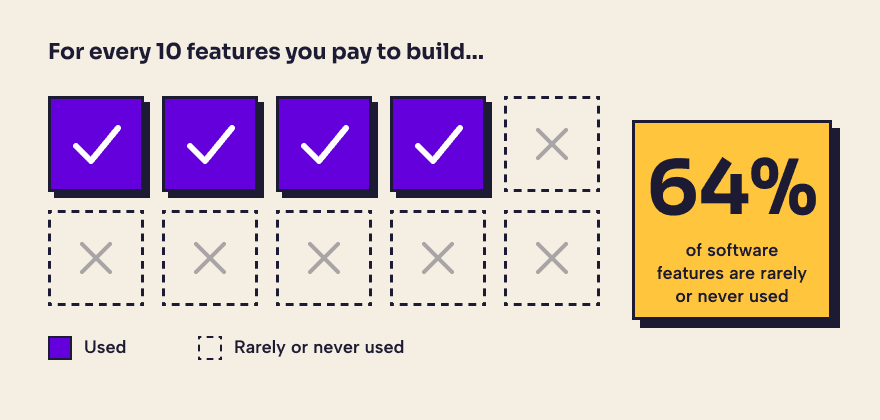
You sign off on a new software project. The team works for six months, the launch goes well, and everyone celebrates. Three months later, nobody is using it. The money is gone, the team is tired, and the competitor down the street shipped something customers actually wanted. Research from the Standish Group found that about 64% of software features are rarely or never used. So for every 10 features you pay a team to build, around 6 do almost nothing for your business.
In a short project, usually 2 to 4 weeks, where you check that you’re building the right thing before you pay to build it. It is known as a Product Discovery, a financial risk mitigation process and a framework for intelligent capital allocation.
In this article, we explore the true return on investment (ROI) of Product Discovery and how it prevents organizations from spending tens of thousands of dollars building the perfect solution for the wrong problem.
How Much Does It Cost to Build the Wrong Solution?
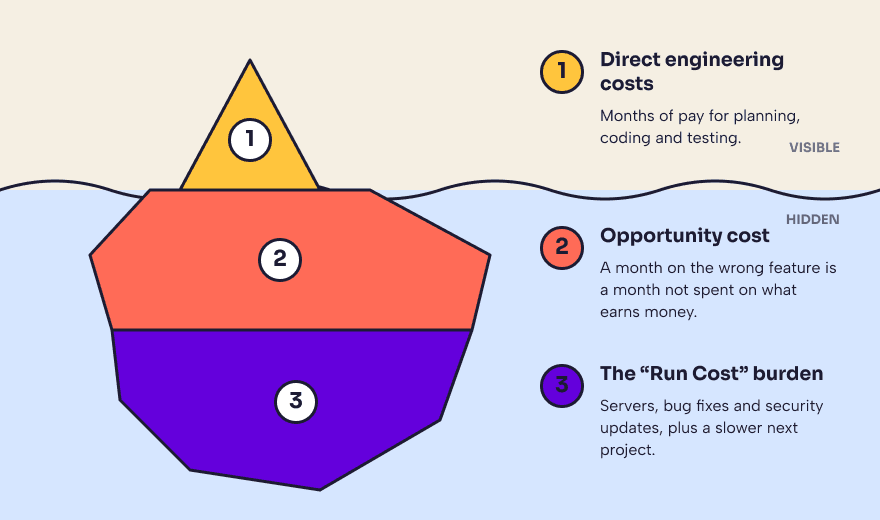
The financial impact of failed software extends far beyond wasted engineering hours. The true cost compounds across three distinct areas:
Direct Engineering Costs
Months of pay for product managers, designers, and developers go into planning, coding, and testing something. If nobody uses it, that money is simply gone.
Opportunity Cost
Every month your team spends on the wrong feature is a month they did not spend on something that brings in money. Maybe a customer was asking for a fix that would have helped you keep them. Maybe a competitor launched something and you needed to respond. That time does not come back.
The “Run Cost” Burden
Unused software does not disappear. You still pay for the servers, the bug fixes, and the security updates. It also makes your next project slower, because the team has to work around code that serves no one.
Building software without upfront validation is the equivalent of committing your annual budget to a horse race without checking if your horse can run.
Where Does Product Discovery Generate ROI?
Discovery protects your money by answering the risky questions before anyone writes expensive code. The payback comes in three ways, and each one comes from specific work the team does.
Knowing the People
We interview 8 to 10 of your customers or users, to learn how they work, and review your sales and support data. For example, if you plan to launch a loyalty program, we ask customers what would make them come back, then check your purchase history to see how often they buy. We find out if the idea can be real for your current users behavior.
Catching Problems Early
We build a clickable prototype in a few days and to test with users. The developers also check the technical side at the same time, like whether your current system can share the data the new tool needs. A confusing screen takes an hour to fix on a prototype. After launch, the same fix can take weeks.
Align Your Company Solutions
We run a workshop with your team where everyone writes down their assumptions, and we test the riskiest ones with users. When your decisions come from what users said and did, the assumptions become certainties, because the evidence is on the table.
How to Calculate Product Discovery ROI
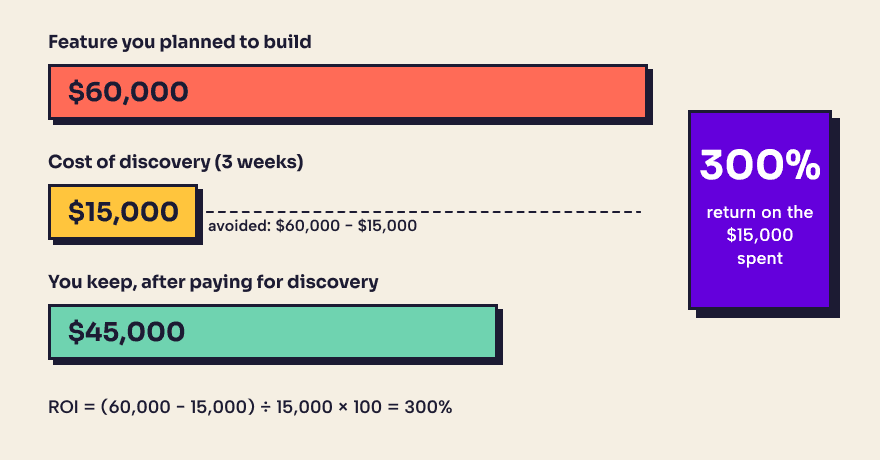
The math is simple. Take the money you saved by not building the wrong thing, subtract what discovery cost you, divide by what discovery cost you, and multiply by 100.
ROI (%) = [(Costs Avoided - Discovery Cost) ÷ Discovery Cost] × 100
Say discovery costs $15,000 for three weeks. It shows you that a feature you planned to build for $60,000 is not needed. You spent $15,000 to avoid spending $60,000, so you kept $45,000 after paying for discovery. That is a return of 300%.
To estimate avoided costs, start with a documented development estimate for the original scope. Compare it with the revised scope after Discovery, accounting for work that has been removed or reduced. These estimates depend on the assumptions used and should not be treated as guaranteed savings.
The example above assumes the $60,000 feature would otherwise have been developed and that its full cost was avoided.
When Is It Worth Investing in Product Discovery?
You do not need discovery for small changes, like moving a button or changing a color. It pays off when the project is new, expensive, or hard to undo. Here are the situations we see most.
Are you launching an app to automate a process? In discovery, we map every step with the people who do the work and measure where time is lost. Often the delay sits in one handoff, like an approval that waits two days in someone’s inbox.
Are you creating a loyalty program to increase sales? The risk here is building a points system that customers never join. In discovery, we interview customers, check what they buy and how often, and test different offers with a simple prototype. We find out whether they care more about discounts, free delivery, or early access, and which one makes them buy again.
Are you adding new features to an existing product? Your team probably has a long list of ideas, and every idea feels important. We use a mix of methods to sort them out: user interviews, short surveys, prototype tests, a review of support tickets, and a look at how people actually use the product today. Together, these show which features people would use every week and which ones would sit untouched.
Are you thinking about using AI in your product? AI sounds like a good idea in almost every meeting, but it only helps when it solves a real problem. In discovery, we find the tasks where your users lose the most time, then test the idea with a small sample of your real data before any big build. We check if the answers are accurate enough and if users trust them. If the test fails, you saved the full cost of building it. If it works, you start with proof.
Real-World Case Study: The Mobile App Nobody Wanted
A metal recycling company came to us on March of 2024 with a clear request. They wanted a mobile app so their drivers could log the type and amount of metal at each pickup, right from their phones. The plan was to design and build apps for both iPhone and Android.
Before writing any code, we ask if possible to talk with their drivers, to learn how they work because the application was for them at the end of the day. What we learned was different from what the company expected. Picking up metal is fast work, done in loud places. Taking out a phone, unlocking it, and typing into a form was too slow for them. The drivers wrote the numbers on a paper notepad in about five seconds and kept moving.
We also learned when the data really got entered. The drivers typed everything into the system at the end of the day, sitting at a desk back at the warehouse, usually with a coffee in hand. The mobile app would have made their day harder. What they needed was a fast desktop tool to enter the whole day’s numbers at once.
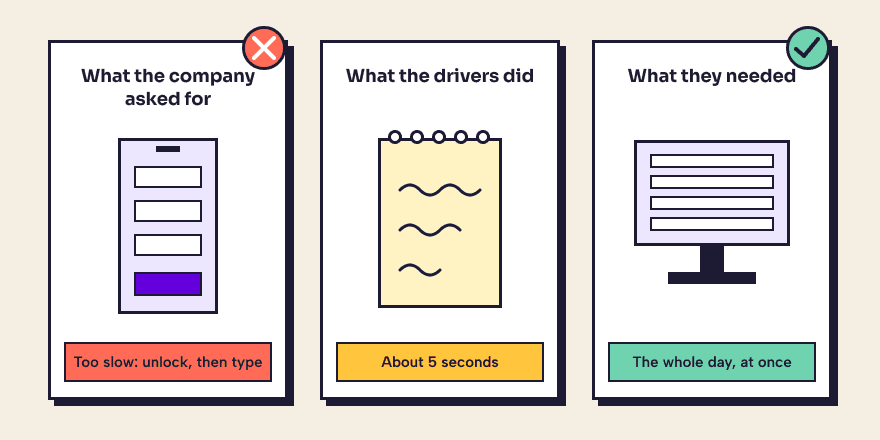
Without discovery, the company would have built the mobile app, watched the drivers ignore it, and then paid to build the desktop tool anyway. They would have paid twice. With three weeks of user interviews, we built a prototype of the right tool once, that was also validated by the drivers.
By conducting Discovery prior to development, the client achieved:
1. Direct Capital Savings: Avoided wasting dollars developing and supporting native mobile apps for iOS and Android that would have been abandoned.
2. Eliminated Change Resistance: Software introduced without field context creates resistance. By involving operators in the Discovery phase, the team felt heard. The resulting desktop solution complemented their natural habits, leading to 100% immediate adoption.
3. Faster Time-to-Value: Engineering resources were directed immediately toward the correct desktop product, shipping faster and avoiding costly post-launch redesigns.
So, Is Discovery Worth It?
Product Discovery does not slow you down, it is the most reliable accelerator your business can implement.
By shifting the organizational focus from “how fast can we build this?” to “should we build this, and why?”, you turn your development project from an unpredictable cost center into a predictable driver of financial ROI.
If you want help running a discovery phase for your next project, let’s talk.