
When organizations evaluate the performance of their internal applications, the metrics tend to be relatively predictable: response time, platform availability, number of incidents, maintenance costs, and compliance with functional requirements are usually at the top of the list.
However, there is a factor that rarely appears in financial reports, yet still has a direct impact on productivity, operational costs, and employee satisfaction: the user experience.
The problem is that poor User Experience rarely causes a critical failure. Applications continue to work, processes continue to run, and objectives are still achieved. But behind this apparent normality, small moments of friction accumulate, consuming time, increasing the likelihood of errors, and reducing team efficiency as users have to find workarounds.
Unlike system downtime, which is immediately visible, the costs associated with poor digital experiences are silent. And this is precisely why so many organizations underestimate them.

The sum of small frictions
Most UX problems in enterprise applications are not related to missing functionality. On the contrary, systems often do exactly what they were designed to do. The issue lies in how those capabilities are presented and used.
Overly complex menus, confusing navigation flows, excessively long forms, information scattered across multiple screens, or processes that require more steps than necessary are common examples of friction that affect thousands of daily interactions.
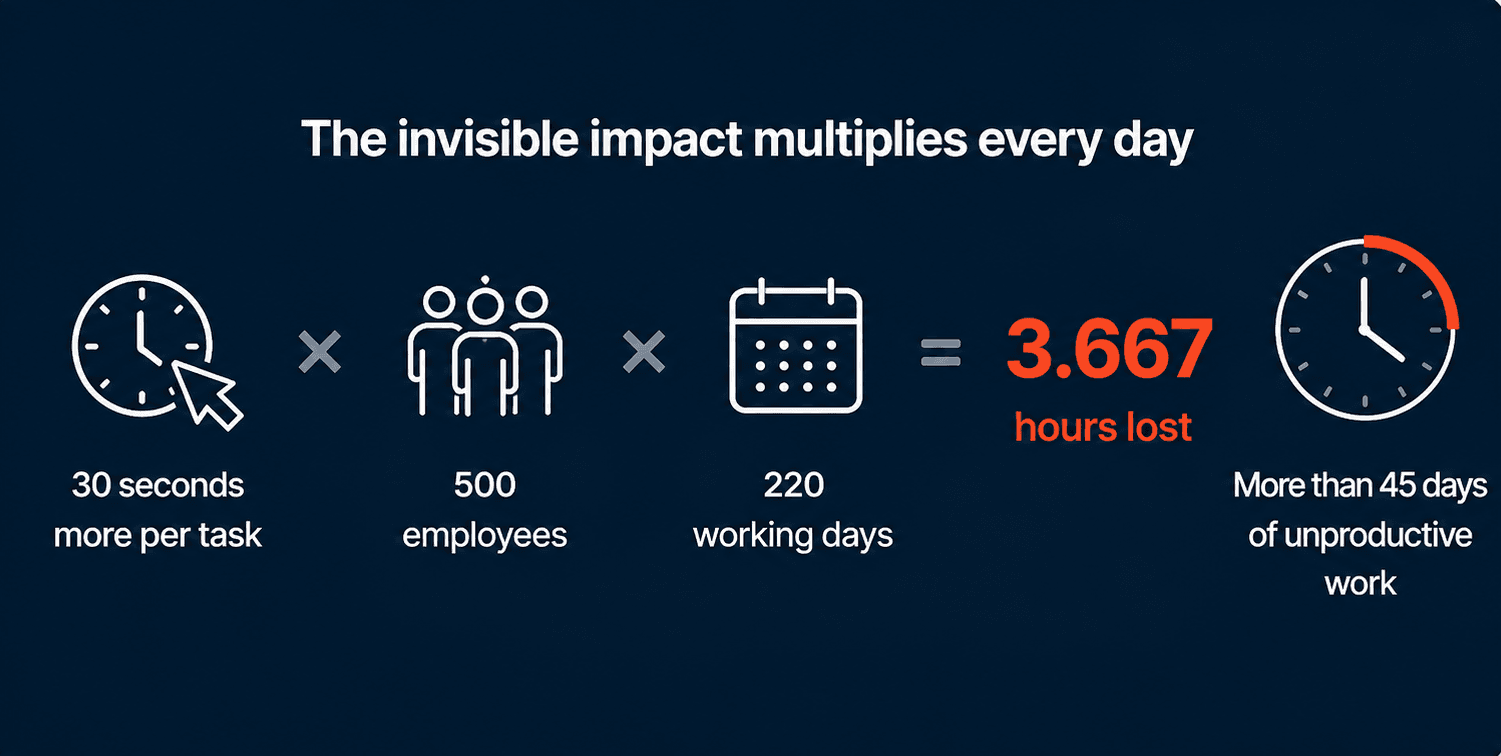
Individually, each of these issues may seem insignificant. A few extra seconds to find a feature or a couple of additional clicks to complete a task rarely justify a transformation initiative. However, when multiplied across hundreds of employees and thousands of operations over months or years, the impact becomes substantial.
What seems like a matter of convenience gradually turns into a matter of operational efficiency.
When productivity is not only about people
In many organizations, difficulties in task execution are often attributed to lack of training, resistance to change, or human error. While these factors may exist, the role that tools themselves play in team productivity is often overlooked.
An employee who needs to navigate through multiple screens to retrieve a simple piece of information is not necessarily working inefficiently. Often, they are simply using a system that was not designed to support the way they work.
The same applies when users constantly rely on more experienced colleagues to complete basic processes, consult documentation for recurring tasks, or develop workarounds to overcome system limitations. These behaviors become normalized within teams, but they are clear signs that the user experience is not aligned with real business needs.
As complexity increases, productivity is no longer solely dependent on people’s skills, it also depends on the quality of the tools they use every day.
The impact that doesn’t show up in reports
One of the reasons UX is still undervalued in many enterprise projects is the difficulty of measuring its impact directly.
It is relatively easy to calculate the cost of infrastructure failure or service downtime. The cost of an unintuitive navigation flow or an overly complex process, however, is much harder to quantify.
Still, its effects appear across multiple areas of the organization: increased support requests, longer training times, slower process execution, and higher operational error rates are often symptoms of poor user experience.
There is also a less tangible but equally important factor: the perception employees develop about the tools they use. When an application is seen as a barrier rather than an enabler, adoption tends to decrease and overall satisfaction with digital processes gradually declines.
The result is a difficult cycle to break: the more complex the experience becomes, the lower user adoption; the lower the adoption, the harder it becomes to justify further investment in improvements.
The new generation of digital expectations
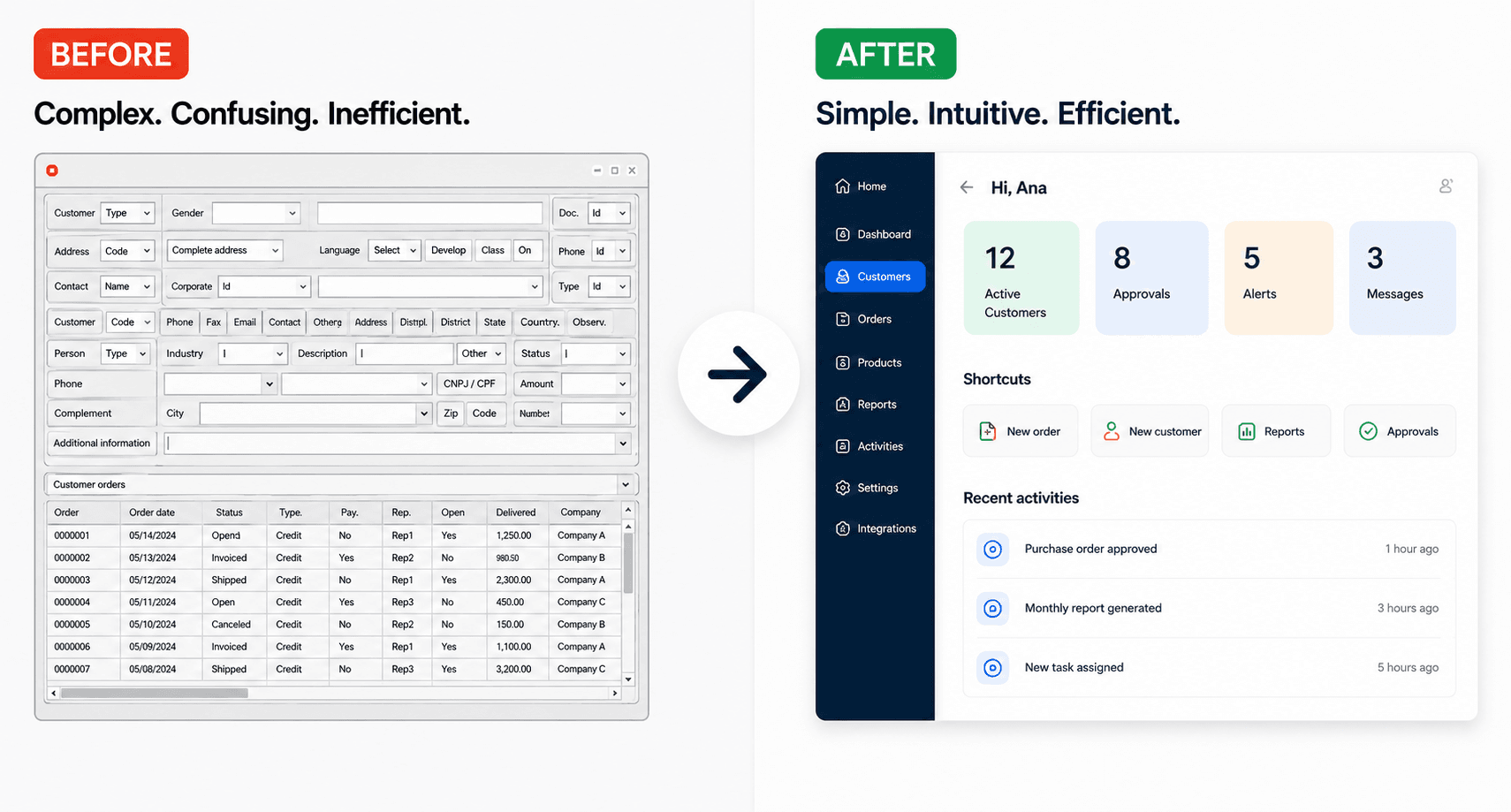
In recent years, UX has no longer been limited to customer-facing applications. Digital transformation and increasing exposure to high-quality digital experiences have led employees to expect the same level of simplicity and efficiency in enterprise tools.
People use applications daily that anticipate needs, simplify tasks, and present information in a contextual way. When they return to corporate systems designed according to paradigms from ten or fifteen years ago, the difference becomes obvious.
This shift in expectations is creating new pressure on organizations. It is no longer enough for an application to simply work correctly, it must work intuitively, efficiently, and in alignment with user goals.
Organizations that recognize this reality are beginning to treat UX not as an aesthetic layer added at the end of a project, but as a strategic element that directly influences productivity, adoption, and return on investment.
UX as an operational investment
For a long time, user experience was seen as a topic related to design or the visual layer of applications. Today, that perspective is increasingly limited.
Good UX is not just about more pleasant interfaces. It means faster processes, fewer errors, reduced support dependency, and more efficient use of available resources. It means building tools that help people work better, rather than adding complexity to their work.
As organizations continue investing in digital transformation, the quality of the experience offered by enterprise applications will become an increasingly important differentiator. Not only because it improves user satisfaction, but because it directly influences how the business operates.
The true cost of poor UX rarely appears on a budget line. But it manifests daily through wasted time, accumulated frustration, and lost opportunities. And for many organizations, this may be one of the highest costs of all.
The first step toward changing that is simply paying attention to what is already there: the workarounds people have invented, the questions asked repeatedly, the processes that take longer than they should. Those signals are already present in every organization. They are just waiting to be read.
Why is User Experience (UX) important in enterprise applications?
User Experience (UX) directly impacts how efficiently employees complete their daily tasks. Well-designed enterprise applications reduce cognitive effort, minimize errors, shorten training time, and improve adoption. While poor UX may not cause system failures, it creates small but constant inefficiencies that accumulate into significant operational costs over time.
How does poor UX affect business productivity?
Poor UX slows employees down through confusing navigation, unnecessary steps, repetitive tasks, and difficult-to-find information. These small frictions increase the time required to complete processes, generate more support requests, encourage workarounds, and raise the likelihood of human error. Across an entire organization, these inefficiencies can have a measurable impact on productivity and operational performance.
Can investing in UX reduce operational costs?
Yes. Investing in UX can lower operational costs by streamlining workflows, reducing training requirements, decreasing support tickets, and minimizing costly mistakes. Although the return on investment is not always immediately visible, better user experiences help employees work more efficiently and enable organizations to get greater value from their existing digital solutions.
What are the signs that an enterprise application has poor UX?
Common indicators include employees struggling to find information, relying heavily on documentation or experienced colleagues, creating manual workarounds, submitting frequent support requests, and expressing frustration with everyday tasks. These behaviors often signal that the application is creating unnecessary friction and that improving the user experience could significantly enhance productivity and user satisfaction.